Forti5 Technologies · UNISA M. Ramachandran

Professor of Cyber Security, AI and Blockchain

Muthu
Ramachandran

Every generation of technology arrives before the engineering discipline that would make it safe to use. I have spent thirty-five years supplying that discipline — first for software reuse, then the cloud, then security, now AI and blockchain.

  • PhD Lancaster, under Ian Sommerville
  • FBCS · SMIEEE · SMACM · FIoA · SFHEA
  • ISO/IEC 25059 contributor, JTC1/SC42

And, unusually for a professor: a currently certified IASME / NCSC Cyber Essentials, Cyber Essentials Plus and IoT Assurance assessor, and Cyber Advisor. I assess real organisations against real controls every week, which is where the research gets tested.

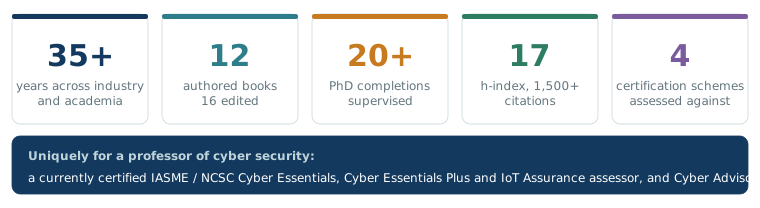
Snapshot: 35+ years across industry and academia, 12 authored books and 16 edited, 20+ PhD completions supervised, h-index 17 with over 1,500 citations, four certification schemes assessed against.
01

Research

Frameworks and methods a practitioner can pick up and apply, rather than observations about a phenomenon.

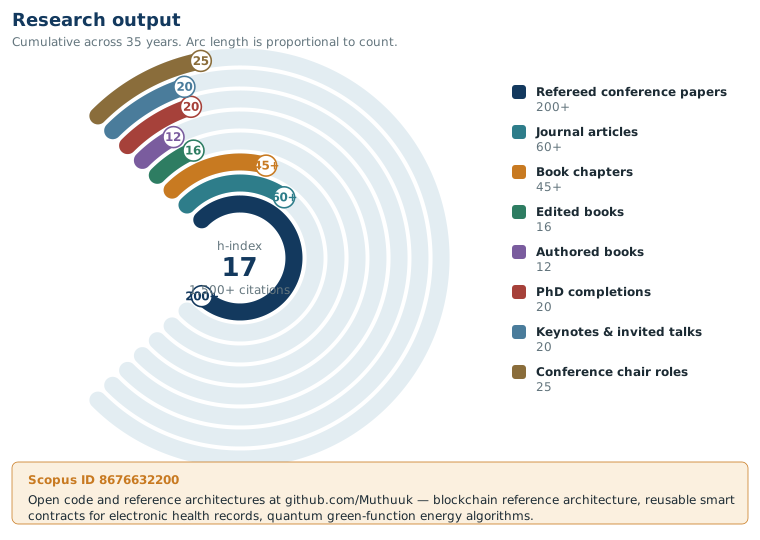
Radial chart of research output: 200+ refereed conference papers, 60 journal articles, 45+ book chapters, 16 edited books, 12 authored books, 20 PhD completions, 20 keynotes, 25 conference chair roles. Centre shows h-index 17 and over 1,500 citations.
Output by type across thirty-five years. Arc length is proportional to count.
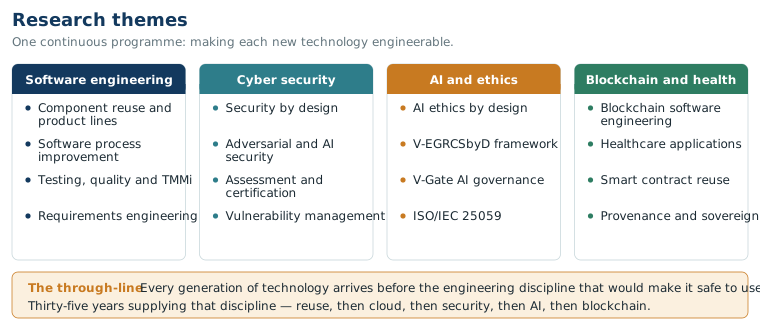
Four research themes: software engineering, cyber security, AI and ethics, blockchain and health — each with four sub-areas.
Four themes, one continuous programme.

Frameworks originated

  • V-EGRCSbyD — Validation, Ethics, Governance, Risk, Compliance and Security by Design
  • V-Gate — incident-grounded pre-deployment AI governance
  • SEF-SCC — software engineering framework for service and cloud computing
  • PRISM — software process improvement, deployed in four companies
  • Koala — component model, co-originated at Philips and shipped in products

Funded research

  • ESPRIT/FP5 MultiSpace — £3m, work-package lead
  • FP5 ARES; FP7 AGUASOCIAL; EPSRC viewpoint-oriented test and quality
  • Ten TEXMiN projects, Dept. of Science & Technology, India
  • Microsoft Azure and Elsevier ICSR Lab awards
  • Advance HE ICS Development Fund; NTI Innovation Voucher

Recognition

  • European Identity & Cloud Award 2016 — Best Project in Research
  • Top Blockchain Voice, LinkedIn 2023
  • Global Excellence Award 2023, Anexas Consultancy SE
  • IGI Global Excellence in Research Journal Award 2015
  • Judge, Computing AI & Software Development Awards 2026

Selected recent publications

  1. 2026 Lightweight consensus for blockchain–IoT in smart cities: a hierarchical framework. Academia Engineering, 3(2).
  2. 2025 with S. Fouracre. Rich data versus quantity of data in code generation AI. Blockchain in Healthcare Today, 8.
  3. 2025 with T. J. Chaffer. AI agents in healthcare: the need for governance. Telehealth and Medicine Today.
  4. 2024 Ethics of blockchain by design: guiding a responsible future for healthcare innovation. Blockchain in Healthcare Today, 7.
  5. 2023 S3EF-HBCAs: a secure and sustainable framework for healthcare blockchain applications. Blockchain in Healthcare Today, 6.
  6. 2016 with V. Chang. Towards achieving cloud data security with the Cloud Computing Adoption Framework. IEEE Transactions on Services Computing, 9(1) — the journal’s most-accessed article.
  7. 2016 Software security requirements engineering and management as an emerging cloud service. Int. Journal of Information Management, 36(4).

Full publication list · ORCID · Scopus · Code on GitHub

02

Teaching

Producing judgement, not recall. Students will spend a career making decisions under uncertainty, with incomplete information.

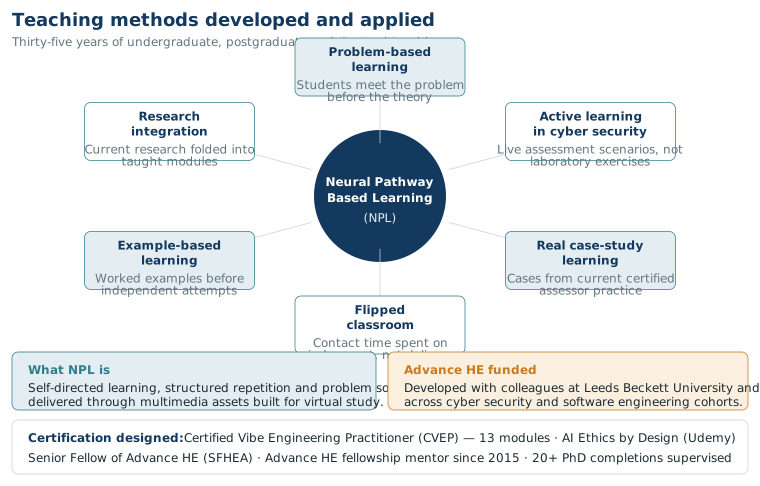
Teaching methods radiating from Neural Pathway Based Learning at the centre: problem-based learning, active learning in cyber security, real case-study learning, flipped classroom, example-based learning, and research integration.
Six methods around Neural Pathway Based Learning, developed with Advance HE funding.

Modules designed and led

  • Secure Software Engineering (Level 6, from 2011)
  • Computer Forensics
  • Software Security Engineering
  • Service-Oriented Architecture
  • Cloud Computing Development
  • Research Practice and Dissertation

Programmes validated

  • MSc Software Engineering
  • MSc Managing Software Development
  • MSc Mobile and Distributed Systems
  • MSc Web Engineering
  • MEng pathways; computer forensics and cloud provision

Certification designed

  • CVEP — Certified Vibe Engineering Practitioner, 13 modules on governed AI-assisted development
  • AI Ethics by Design — online course, Udemy
  • AWS Educate Educator; Certified DevOps Software Engineer
20+PhD completions supervised
20+further doctorates advised or examined
9universities examined for, over 20 years
2015Advance HE fellowship mentor since

Graduates now hold chairs and senior industry posts in the UK, Sudan, Jordan, India and beyond. Voted Postgraduate Research Supervisor of the Year in the Golden Robes awards.

03

Books

Twelve authored, sixteen edited, forty-five chapters. A textbook adopted onto a programme reaches every student who takes the module, for years.

Springer · 2026

AI for Cybersecurity

Volume 1 — Principles, Frameworks, and Practical Implementation

978-3-032-17366-9

View →
Springer · 2026

AI for Cybersecurity

Volume 2 — Emerging Technologies, Ethics, and Societal Impact

978-3-032-25873-1

View →
Springer Nature · 2026

Engineering Ethics of AI by Design

Principles, Practices, and Frameworks for Responsible AI

978-981-95-2908-7

View →
Elsevier · 2027

Ethics of Blockchain by Design

Security, privacy, governance and sovereignty as design problems

978-0-443-48511-4

View →
Springer · 2025

Blockchain Software Engineering

Secure and Sustainable Frameworks for Healthcare Applications

978-981-96-4359-2

View →
In production

Five more, 2027

AI for Modern Software Engineering (Springer) · AI for Software Testing of Modern Applications (CRC) · AI for Software Engineering Productivity and Quality (Elsevier) · A Clinical Guide to AI in Healthcare and Strategic Guide to AI in Healthcare (Routledge)

04

Practice

The part that keeps the research honest. I see where national guidance breaks down, because I watch it break down.

Certified assessment

IASME / NCSC certified assessor for Cyber Essentials, Cyber Essentials Plus, IoT Cyber and IoT Assurance, and NCSC Cyber Advisor. Assessment, technical verification and remediation for UK SMEs, charities and professional-service firms.

Data protection

Lead assessor for UK GDPR and data protection audits, including a multi-department programme producing eight formal findings reports and a cross-organisational risk analysis.

Vulnerability management

Nessus and Qualys-driven remediation across client estates — CVE-2013-3900 WinVerifyTrust, unquoted service paths, AutoPlay and account hardening.

Platform architecture

Architect and delivery lead of the Forti5 assessment platform: a SaaS product combining assessment workflow, agent-based host scanning and vulnerability reporting.

Standards

ISO/IEC 25059 (SQuaRE quality model for AI-based systems) within ISO/IEC JTC1/SC42. Co-creator of the BCS SIGiST component-testing standard, 1994 onwards. Board member, TMMi Foundation.

Conference founding

Founding Co-Chair of ABH 2026, the first International Conference on AI and Blockchain in Healthcare (Porto, July 2026), now an annual series. Conference Chair, SE-CLOUD 2018 and 2019.
05

Career

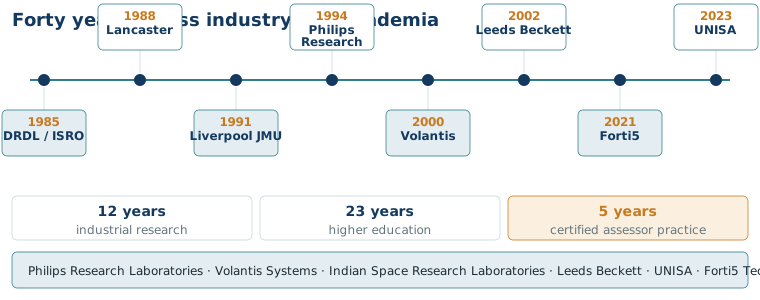
Twelve years in industrial research, twenty-three in higher education, five in certified practice.

Timeline from 1985 to 2023: DRDL/ISRO, Lancaster PhD, Liverpool John Moores, Philips Research, Volantis, Leeds Beckett, Forti5, UNISA.

Now

2023–
Professor Extraordinarius, School of Computing (CAIDS), University of South Africa
2021–
Principal Research Consultant & Certified Cyber Security Assessor, Forti5 Technologies
2023–
Visiting / Adjunct Professor: IIT (ISM) Dhanbad · SIIT Thammasat · Lincoln University College · Southampton
2014–
Editor-in-Chief, International Journal of Organizational and Collective Intelligence

Before

2002–21
Principal Lecturer & Head of SETEP Research Group, Leeds Beckett University
2000–01
Principal Software Architect, Volantis Systems
1994–00
Senior Principal Research Scientist, Philips Research Laboratories
1991–94
Senior Lecturer & Course Leader, Liverpool John Moores University
1985–88
Senior Research Scientist, real-time high-integrity systems, DRDL / ISRO

Collaborations

SouthamptonTeessideNTNU Trondheim IBM T. J. WatsonUESTC ChengduIIT (ISM) Dhanbad TEXMiNNECTEC ThailandNikola Tesla, Belgrade Foundation University IslamabadSAP ConcurSynamedia